
Searching Iron County Criminal Dockets
Missouri Case.net is the official public search. Already have a criminal case number? The Case Number Search is your most precise tool. Without one, run a Litigant Name Search. Then trim the results with Iron County or 42nd Judicial Circuit filters, the criminal category, and a filing year if the live form allows. Common names demand extra care, since the results can pile up. Check the case type and filing date before deciding a result is your case.
Open the case header first. It shows the court, category, filing date, and listed parties at a glance. Then read the current Docket Entries. Does the search leave questions? Ask the Iron County Circuit Clerk whether a public docket sheet, judgment, or disposition is available. A narrow request works better than asking for the whole file. That full file may hold restricted material, so it can cost more search or copy time.
- Choose Case Number Search when the CR number is known.
- Use a legal name and narrow by court, category, or filing year when it is not.
- Confirm the case header before relying on a result.
- Read Docket Entries for the sequence of criminal court events.
- Contact the Circuit Clerk for a current public copy or a division question.
Iron County CR Case Routing
Missouri marks criminal matters with the CR prefix. A case can start in one division. It may later be transferred or bound over, so the search may need a different number or wider filters. Iron County sits in the 42nd Judicial Circuit, a five-county circuit. Its associate, circuit, municipal, and treatment-court paths all live inside that circuit structure. A municipal matter can enter through a city. It can still end up as a Circuit Clerk record.
The 42nd Judicial Circuit local rules name two circuit judges, an associate circuit judge in each county, and treatment court in each county. Does a name search come up empty? Try the state filters. Then ask the clerk whether the matter was transferred, indexed under another spelling, closed, or moved to a different division.
Inside an Iron County Criminal Docket
A public criminal docket may show the case number, filing date, case style, charge or offense description, public party roles, event dates, motions, hearings, pleas, judgments, sentencing entries, and which public documents are available. The view shifts with case status and confidentiality rules. Remember that a charge is only an accusation. A plea, a finding, a judgment, a sentence, a dismissal, and a later closure each carry a distinct meaning in the court record.
| Case number | A Missouri criminal identifier such as CR-[year]-[sequence]. |
|---|---|
| Charge label | A public charge or offense description, which is not a finding by itself. |
| Setting | An arraignment, pretrial, trial, review, or other scheduled court event. |
| Plea or ruling | A recorded court event that must be read with its date and context. |
| Disposition | A dismissal, judgment, sentence, or other recorded result when public. |
| Document availability | A possible public link, not a promise that every attachment is viewable. |
Any example here stays redacted: CR-[year]-[sequence], the defendant's name withheld, and one dated event such as arraignment. A real Iron County case, or a private person's identifiers, never belongs in a public explanation.
Iron County Docket Entry Meanings
Read a criminal docket as a timeline. CourtListener is a public court-record discovery source. It is not an Iron County criminal docket source, and it does not replace Case.net or the clerk.
Any secondary lead deserves a check against the court's current record. In an Iron County criminal docket, a hearing entry shows a scheduled or recorded event. That is all. It does not settle the truth of a charge or the final result by itself.
- Arraignment
- A court event at which charges and a response may be addressed.
- Pretrial
- A setting before trial that can concern motions, discovery, or case management.
- Disposition
- The recorded procedural or final outcome, such as a dismissal or judgment.
- Sentencing
- A later court event that is separate from the charge and, in some cases, the plea.
How a Criminal Case Moves
Criminal cases rarely follow one script, yet the docket often traces a familiar arc. A filing or charge comes first. Arraignment and pretrial settings follow. From there the case may move to a plea. It may instead head to a trial, a dismissal, or another procedural event. A judgment or disposition can come next. After that, the docket may record sentencing, a compliance event, an appeal, or closure. Read every entry alongside the ones before and after it.
Docket flow: Filing → Arraignment → Pretrial → Plea or Trial → Disposition → Sentencing.
A scheduled event is not an outcome. For an upcoming setting, confirm the division, date, time, and event type with the Circuit Clerk before you drive over. A reset or continuance only moves a date. It does not dismiss a criminal case by itself.
Iron County Criminal Clerk Access
The Iron County Circuit Clerk keeps court records for criminal matters. Civil, probate, domestic, and juvenile cases sit there too. The official clerk contact is 250 South Main Street, Ironton, Missouri 63650. Phone 573-546-2511. Email ironcounty@courts.mo.gov. Listed hours run 8:30 a.m. to 4:00 p.m. Call ahead before a long trip. The county's official material does not confirm public-terminal hours, room details, or current delivery methods.
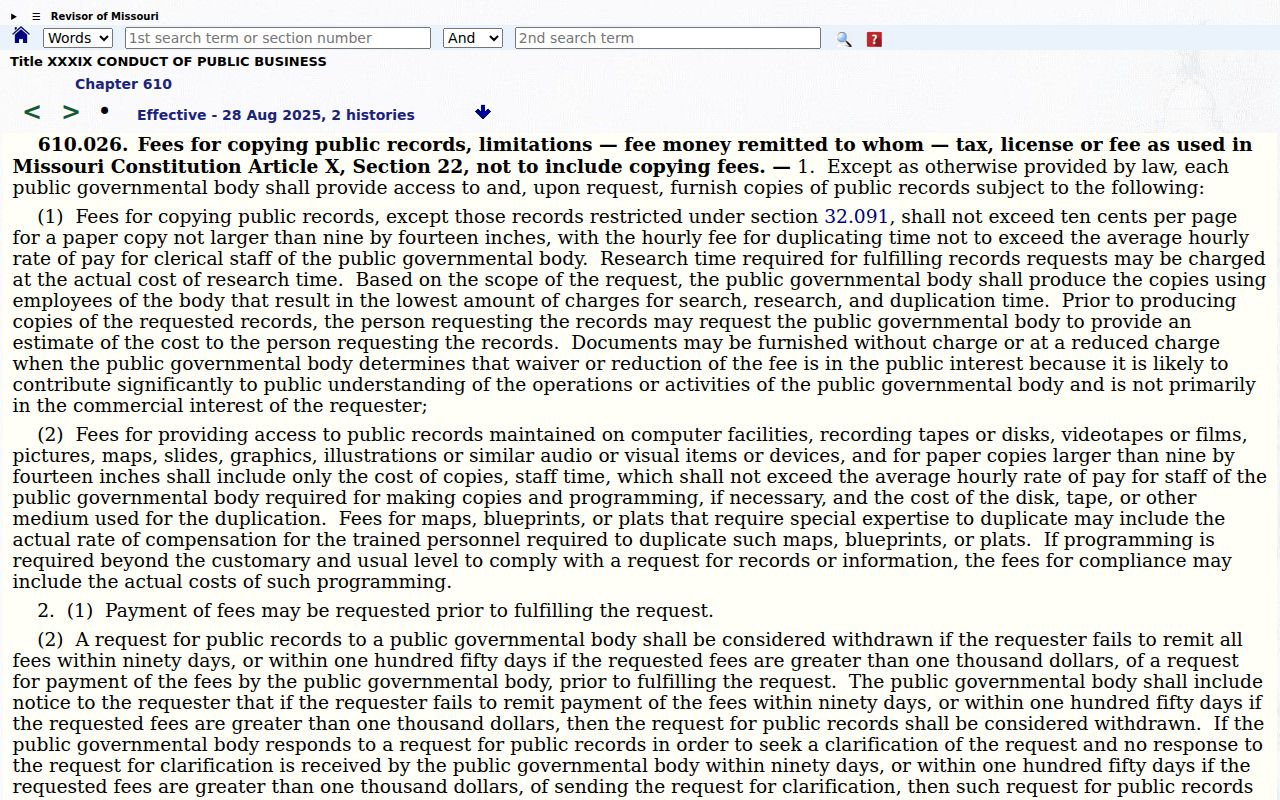
RSMo §610.026 is the general public-record statute covering copying and research costs. That official statutory source sets out the statewide framework. It is not a current Iron County Circuit Clerk fee schedule.
Ask the clerk for today's cost of an ordinary copy, certified copy, docket sheet, judgment, transcript, or inspection. Court-specific fees can differ from a general Sunshine-law amount. The clerk can also explain whether mailing, pickup, electronic delivery, or another channel is offered.
Iron County Criminal Terminal Access
Case.net can find an Iron County criminal docket entry. The paper behind it is a separate matter. Missouri's file-viewer help draws the line plainly. A hyperlinked entry means an attached document may be viewable by the current user. A nonhyperlinked entry may carry no document at all. Or it may hold one blocked by that user's access level. Either way, no one should guess what a hidden attachment says. Court Operating Rule 4 does its part. It requires the automation system and equipment for public access, always subject to the court's confidentiality rules.
Electronic cases marked ECASE add a wrinkle. The official eFiling information says a public user may need a courthouse terminal for some documents. Remote access to many public filings widened on July 1, 2023. Anything filed before that date usually comes back to the terminal question. The Iron County clerk posts no confirmed public-terminal hours, room, card-payment option, or electronic copy-order service. Call the Circuit Clerk first. Describe the exact docket or document you need. Ask which access channel is open right now.
Courts That Hold Criminal Dockets
Iron County sits in the Missouri Circuit Court, 42nd Judicial Circuit. That is the trial-court structure to know. Its criminal docket work can move through the circuit and associate divisions. Municipal divisions belong to the same circuit system. Even a city police agency case points back to Case.net and the Circuit Clerk. A municipal citation does too. Either way, the path leads to a public Iron County criminal docket.
A city office might help you spot an ordinance or the issuing agency. It is not the automatic home of a complete court file, though. A public criminal result may show up under another division or a different case number. Ask the Circuit Clerk. The clerk can explain the record route and whether a public copy exists.
Iron County Docket Redaction Rules
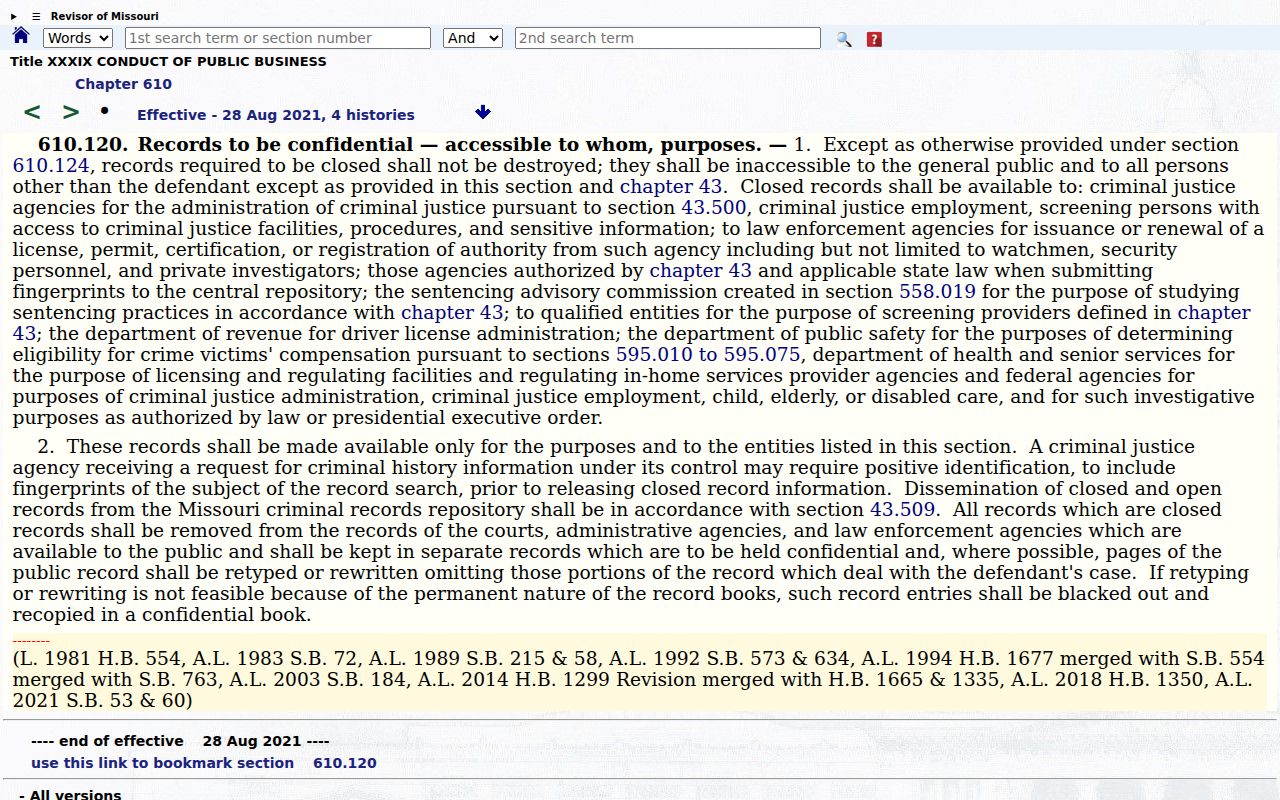
RSMo §610.120 limits what the general public may see in a closed record, and the official statute page spells out those limits.
Closed-record rules are not the only boundary. Missouri redaction rules shield full Social Security numbers. They also protect complete account information, full operator-license or state-ID details, minor identifiers, and protected dates of birth. A docket line may show an item exists while the attachment stays unavailable. Be careful what you keep. Never save or share a result containing a private identifier.
Sealed Dockets and Public Access
Access for the public is not access to everything. Juvenile matters may be withheld or redacted. So may family cases, expunged and sealed files, closed records, medical data, protected addresses, and victim or witness information. A missing Case.net result has many possible causes: a name spelled differently, a transfer, an access restriction, an expungement, or a search that missed the record. None of it proves a person has no court history or that a case never existed.
Access limits to remember:
RSMo §509.520 protects designated personal identifiers in court filings.
RSMo §610.140 provides the expungement procedure and confidential treatment after an order.
Missouri file-viewer help explains that document access can depend on role and security level.
Someone authorized to see a restricted record should start with the Circuit Clerk. Ask what the court requires. That may be identity proof, party authorization, attorney appearance, a court order, or a motion. The right question is whether a specific document is available. Working around a restriction is not.
Iron County Criminal Case Absences
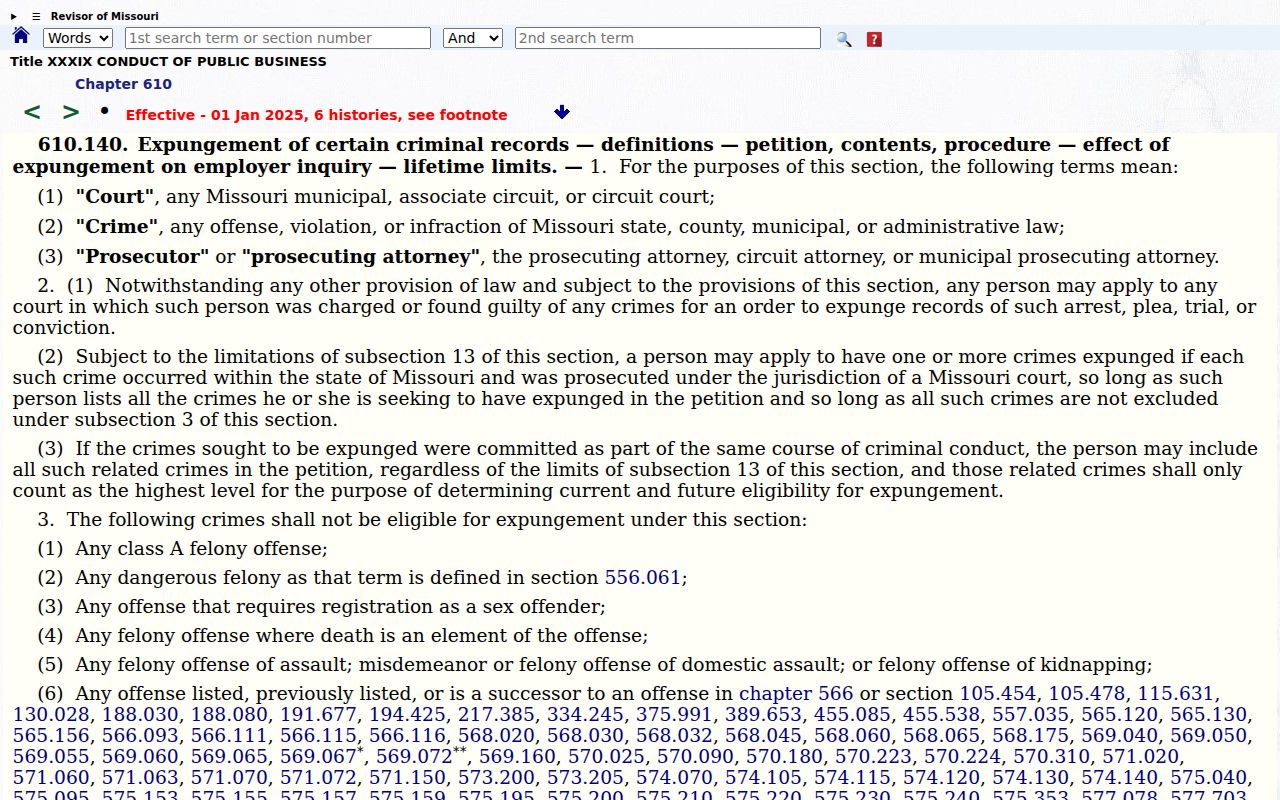
RSMo §610.140 lays out a petition, notice, objection, hearing, and confidential-record path for expungement. The official statute page explains that access rule; it does not concern any named Iron County criminal case.
Do not rebuild an expunged or restricted record from stray fragments. A sparse search result is not a legal conclusion. For a personal case question, ask the clerk. The clerk can point to the proper court procedure or say whether a public docket copy exists. Remember what a court docket is: a court-information tool, not a criminal-history certification product.