
Iron County Court Calendars Explained
Iron County hearing schedules live inside the Missouri Circuit Court system for the 42nd Judicial Circuit. Court Operating Rule 4 makes calendars one statewide system. It sorts events by date, time, judge, and location. The Iron County Circuit Clerk holds the trial and hearing schedules. The same office holds the civil, criminal, probate, domestic, juvenile, municipal, and traffic files. So skip the County Clerk and the Recorder. For any court setting, the docket and the Circuit Clerk come first.
The court posts no separate public calendar page apart from Missouri Case.net. Case.net can find a scheduled event. The case docket shows the fuller chain of filings and entries around it. A municipal matter might land in a municipal division. It might also sit in an associate division or a consolidated clerk calendar. Municipal divisions belong to the circuit-court structure. An event tied to a city ordinance does not necessarily sit in its own city-only judicial file.
Calendar entries look forward. A hearing, trial, review, arraignment, or other setting may appear as scheduled. That does not mean any charge, claim, or allegation has been decided.
Note: For a date-sensitive Iron County setting, treat the calendar as a starting point. Confirm the current entry in the docket or with the Circuit Clerk.
Iron County Court Date Searches
Case.net gives the public four search routes. They are Litigant Name Search, Filing Date Search, Case Number Search, and Scheduled Hearings & Trials Search. The hearing route fits when you know an event date range. A case-number search is tighter, since a notice or citation carries the number. Without it, spell the legal name exactly. Narrow to Iron County or the 42nd Circuit where the live controls allow, and check the case header before trusting a result.
Federal courts sit on a different track. The official Eastern District Bankruptcy case-information search shows a federal docket search on its own system. It runs apart from Missouri Case.net. It cannot substitute for an Iron County state-court date search.
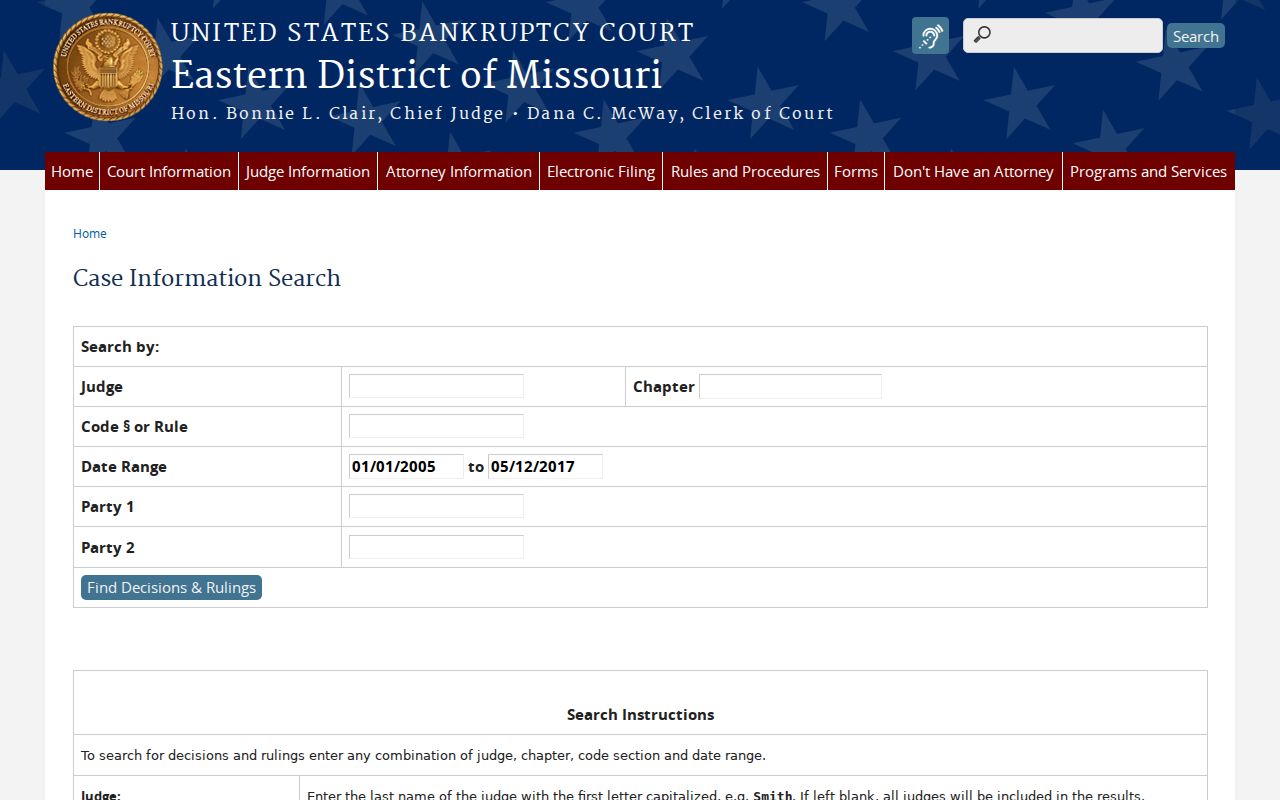
Those distinct fields make the point plain. Use the court system that actually holds the case. Then treat any schedule as an Iron County court setting.
When a result is not clearly from Iron County, widen the Case.net court filter before assuming the case vanished. A transfer, a bound-over path, or a trial de novo can shift the matter to a new number or division.
Finding Your Court Date
Start with the strongest identifier you have. Copy the case number exactly, keeping the year, category, sequence, and any suffix. Missouri categories include CR for criminal. TR means traffic. IN is infraction, CV is civil, PR is probate, and MU is municipal. Once the case comes up, open the current Docket Entries. Compare that event against the Scheduled Hearings & Trials result. A calendar list by itself can be stale.
- Open the official Case.net service and choose the search route that matches what is known.
- Search the exact case number when possible, or use a precise name, a filing window, or a hearing-date range.
- Open the case header and Docket Entries, then identify the next scheduled event, its division, and its location.
- For an Iron County municipal matter, confirm whether the setting is in the municipal, associate, or circuit division.
- Call the Circuit Clerk before travel, especially for a same-day or next-day hearing; the clerk is reached at 573-546-2511.
You can also go in person. The courthouse public terminal and clerk counter sit at 250 S Main Street in Ironton during confirmed court hours. The official Iron County Circuit Court page lists the court email, ironcounty@courts.mo.gov. Ask a focused question with the case number, name, and date. Iron County offers no text-message or email reminder program.
Note: A party's lawyer may receive court notices. A Case.net entry plus clerk confirmation still makes sense when a hearing is near.
Iron County Court Calendar Changes
Missouri calendars can come together late. The municipal clerk manual notes that municipal calendars are often prepared one or two days before the session. Confidential cases stay out of public reports. An Iron County calendar can therefore shift after you search. Treat a reset, continuance, cancellation, dismissal docket, or administrative setting as its own docket event. It is not proof the matter is over.
Court level matters too. The official Cape Girardeau bankruptcy office information shows how a federal proceeding uses a separate court and schedule, even when a party lives in Iron County.
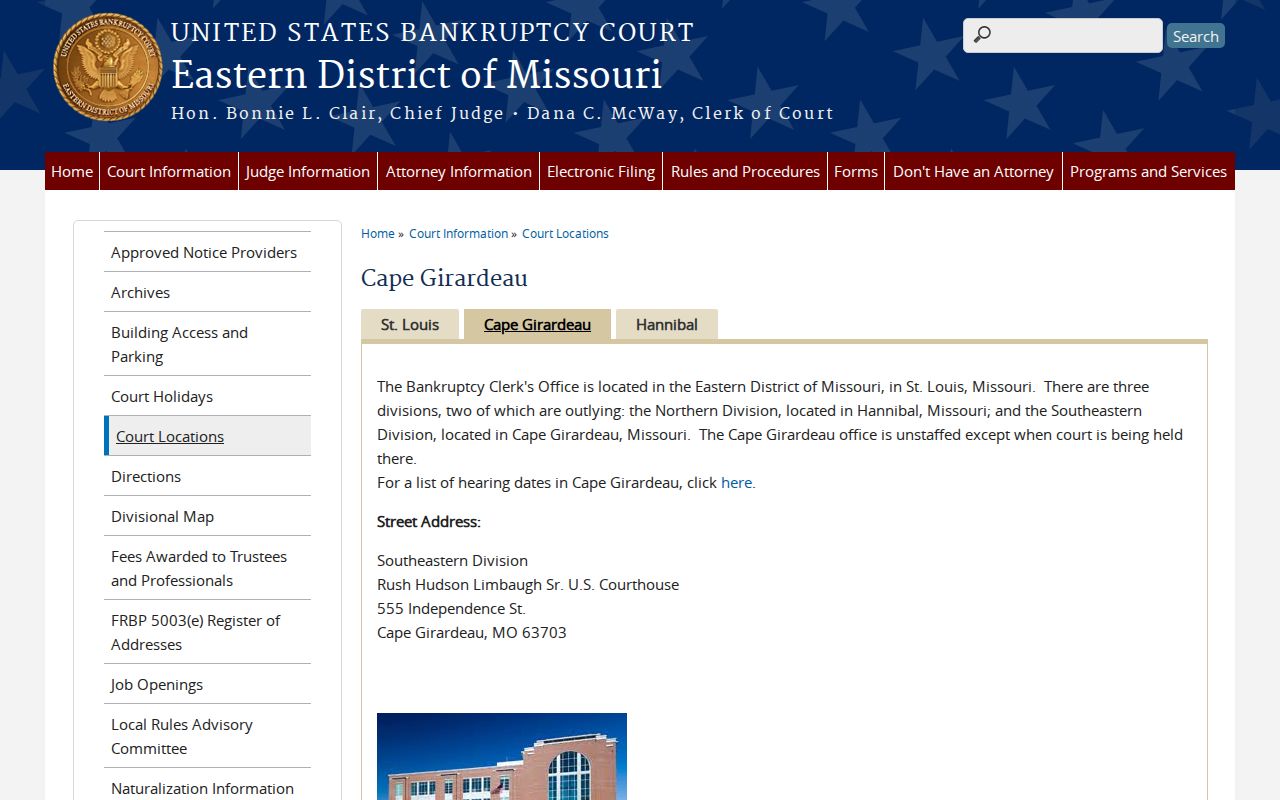
For an Iron County Circuit Court case, confirm the hearing place through the state docket and the local clerk, not a federal location notice.
When a docket says an event was continued or reset, hunt for the later entry that gives the replacement date. If none is visible, call the Circuit Clerk instead of guessing from an earlier calendar row.
How to Read a Court Setting
Every court setting line answers the same basic question: what is scheduled and where. Under COR 4.11, the entry carries a date, a time, a judge, and a location. The event type fills in the rest. That hearing might be an arraignment, a review, a trial, or a bond-forfeiture event. It could also be a dismissal docket or something administrative. Check each field against the case docket itself. A later docket entry can change an earlier setting. Treat the setting as a schedule item only. It is not a result until the court actually rules.
| Date | The scheduled calendar day, which can later be changed by a docket entry. |
|---|---|
| Time | The stated start time or docket-call time; it may not mean the individual matter will begin at that minute. |
| Courtroom | The location or division shown for the event. Confirm it with the clerk before travel. |
| Judge | The judge or court assignment listed for the scheduled event. |
| Setting Type | The kind of proceeding, such as hearing, trial, arraignment, review, or administrative setting. |
Keep two records straight. A docket entry logs what has already happened in a case. A calendar entry points forward to what is coming. Reading both together keeps a future date from being mistaken for a judgment. It also keeps a past entry from looking like your next required appearance.
Iron County Court Setting Terms
Iron County court docket terms each do a different job. The "calendar" lists events that are scheduled. A "docket entry" records the case activity itself: filings, notices, hearings, orders, judgments. A "disposition" is the recorded outcome, final or procedural. A "continuance" moves a proceeding to another point. "Vacated" means a later court action set aside a judgment or order. That is not the same as expungement.
- Scheduled hearing
- A future court event with a date, time, judge, location, and event type.
- Reset
- A court date moved to another setting, normally followed by a later event entry.
- Dismissal docket
- A scheduled docket event that should not be treated as an actual dismissal unless the record says so.
- Backer sheet
- The municipal docket record that summarizes events in a municipal case.
The Eastern District Bankruptcy court page shows a calendar stream entirely separate from the Iron County state docket.
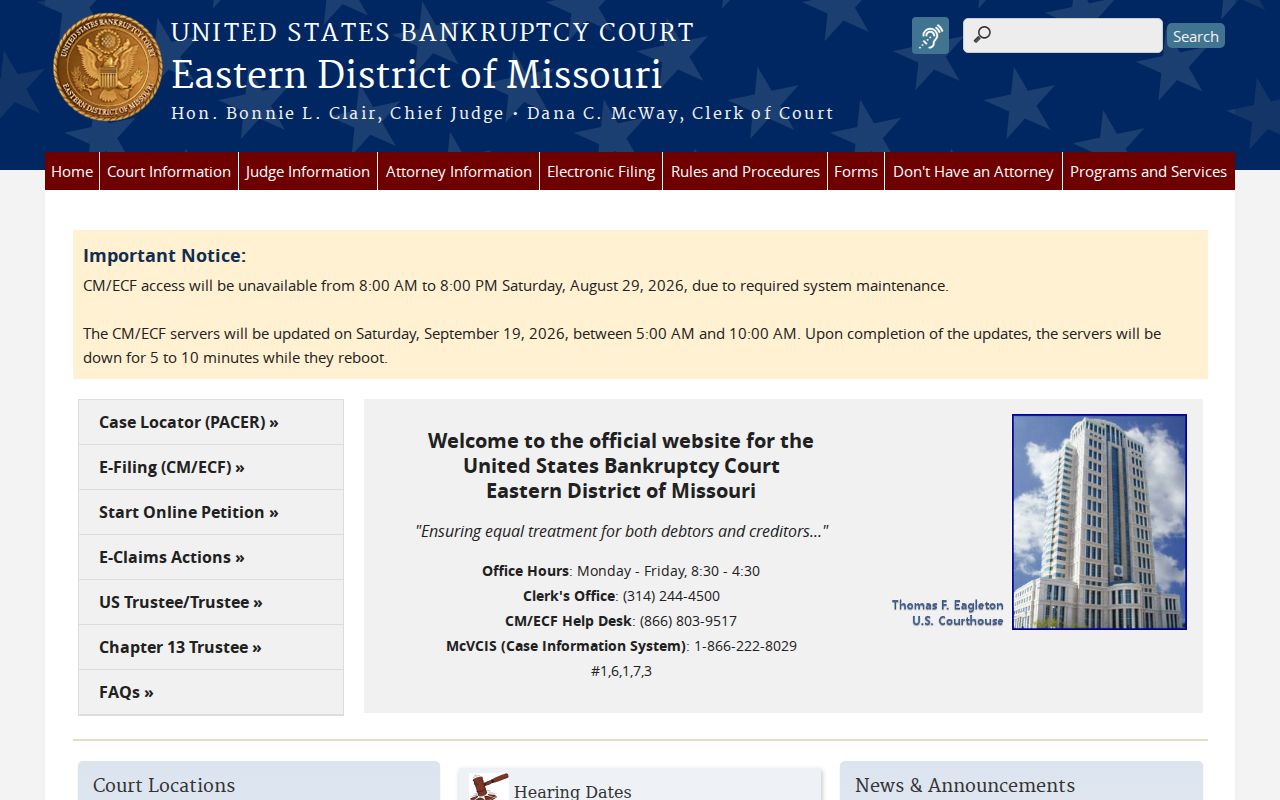
A federal court's contact page cannot confirm an Iron County Circuit Court setting. It still helps show how state and federal calendar systems differ. Note: A confusing docket term deserves a question. Ask the Circuit Clerk to clarify the scheduled event. Ask only about the event, not a predicted outcome.
Continuances, Resets, and Cancellations
Continuances and resets both change the court's schedule. One postpones a setting; the other moves it to a new date. Either change can appear after an earlier calendar row, so the latest Iron County docket entry is the one that counts. A cancellation may follow a court order, a change in division, a case resolution, or some other procedural event. The public calendar rarely explains the reason. Confidential matters may be left out entirely.
Work in order. Start with the case number, read the newest Docket Entries, then confirm the court, judge, and location. If that newest entry is unclear, give the clerk the case number and ask whether a hearing is still set. Never read a calendar removal as proof of a dismissal, payment, plea, or any other disposition. Only the official record speaks to those outcomes.
Older schedules are available too. Request a docket sheet or calendar for an exact date and division, and keep the request narrow so the clerk can find the record without interpreting the full case history.
Iron County Court Date Confirmation
Confirming an ordinary Iron County state case works in three layers. First comes the Case.net search result, then the latest docket entries, then the Circuit Clerk. That third layer matters most. Use it when the event is imminent. The clerk maintains hearing schedules. The clerk can tell whether a matter sits in an associate, circuit, probate, municipal, treatment, or transferred division. A city clerk may help with local routing. The Circuit Clerk is the court-record contact for the judicial docket.
The Eighth Circuit runs its own federal appellate calendar and docket system. For an ordinary Iron County Circuit Court date, it is not the next step.
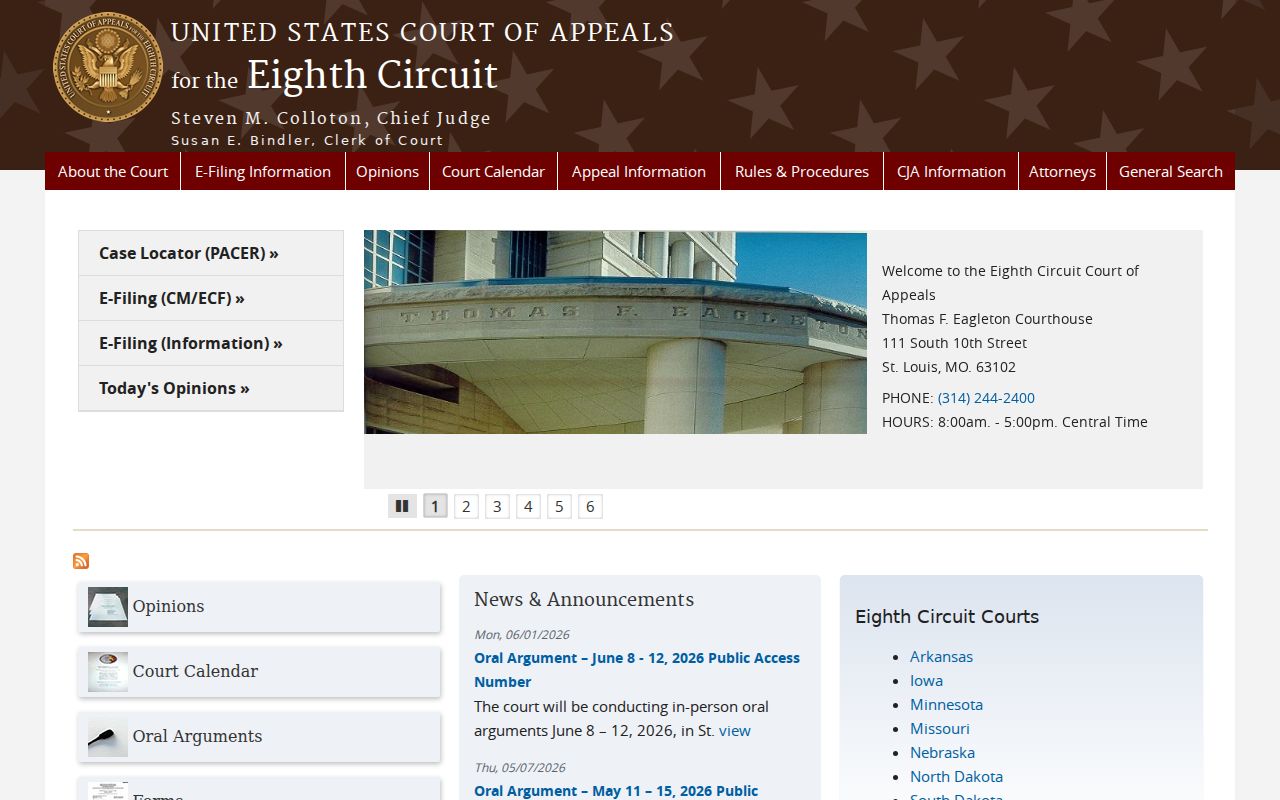
Start with the right court system. That keeps a state-court hearing search clean. It avoids tangles with a later federal appellate proceeding. When a date is only a day or two away, call. A live phone confirmation beats a saved image, a copied calendar row, or an old notice. Have the case number ready, exactly as shown.
If You Miss a Court Setting
Missed an Iron County court setting? Act promptly. Check Case.net first for the newest docket entry and note which division holds the matter. Then call the Circuit Clerk with the case number, ask what the official docket shows, and ask what contact path applies. The clerk can explain record availability and court routing. The clerk cannot give legal advice or change a setting outside the court's process.
Missed setting: A missed appearance can lead to a new setting, a court order, or other consequences that depend on the case and division. Confirm the Iron County docket promptly and follow any notice or court direction rather than assuming the matter was canceled.
A traffic citation brings its own rules. The response deadline printed on the citation matters. Any Fine Collection Center instructions you qualify for matter too. The exact court file remains the source for the scheduled court event. If the case is confidential, sealed, juvenile, or expunged, ask the clerk. The clerk can explain whether public access or an authorized route exists.
Note: A no-result search does not prove an Iron County case never existed. The record may be restricted, indexed differently, transferred, or searched with incomplete information.
Iron County Court Calendar Limits
Every Iron County court calendar has limits. Missouri's file viewer treats entries differently. A hyperlinked docket entry can carry an attachment, while a nonhyperlinked one may have no document or may be locked behind an access level. So the public might see a case header or court docket without every filing. Juvenile, family, sealed, expunged, and other confidential material may be limited or simply missing from search results.
Remote access did expand in 2023. Even so, that change did not end courthouse-terminal access, which still serves older or restricted material. A visitor may need the local terminal or a question to the Circuit Clerk about a particular document. Confidential matters can drop off the calendar entirely. That gap never licenses chasing protected information somewhere else.
The Iron County court docket still does its job. It works for tracking a public hearing, confirming a setting, or requesting a dated record. For a wider search by person or case number, follow the Iron County Case Lookup process and keep that case number intact.