
Getting Iron County Court Records
Most modern Iron County court record lookups start at Missouri Case.net. Use the case number if you have it. A party name, filing date, or hearing date works when the number is unknown. The case header tells you the court, the category, and the filing date. That helps confirm you have the right case. Docket Entries run in order and trace every filing and event. An entry with a link may open a public attachment. An unlinked entry may have none, or it may simply be off limits to you. For anything the index will not hand over, the Iron County Circuit Clerk is the judicial route. Give the clerk a case number, or a full name with an approximate year. Say whether you want to inspect the file, get a docket sheet, a judgment, a specific order, or a certified copy. The clerk can point you to the right division and confirm the item is public. Iron County posts no online copy-order form, local price sheet, fax route, or card-payment option. Confirm those details with the clerk's office before you send any payment.
- Search Case.net by the fact you know best, then confirm the case header and docket category.
- Write down the exact case number, the requested record, and a narrow date range.
- Call, email, or visit the Circuit Clerk to ask whether the item is public and what copy route applies.
- Ask for the current estimate, payment method, delivery option, and whether certification is available.
- Check the received copy against the clerk’s response, especially when a court date or current status matters.
Iron County Court Custodian Boundaries
Court records in Iron County belong to the Circuit Clerk. They do not sit with the County Clerk or the Recorder. Through the consolidated circuit and associate clerk structure, the Circuit Clerk keeps civil, criminal, probate, domestic, juvenile, municipal, and traffic files. It also holds judgments, orders, and hearing schedules. The County Clerk's work is county administration: elections, licenses, budgets, and commission records. Recorder Connie Reed holds deeds, plats, marriage licenses, military records, surveys, liens, and other land instruments. One dispute can touch several offices. Even so, no two of them keep the same record. Route each request to the right one. The Iron County Recorder’s official page shows the separate land-record office and its online-record-search context.
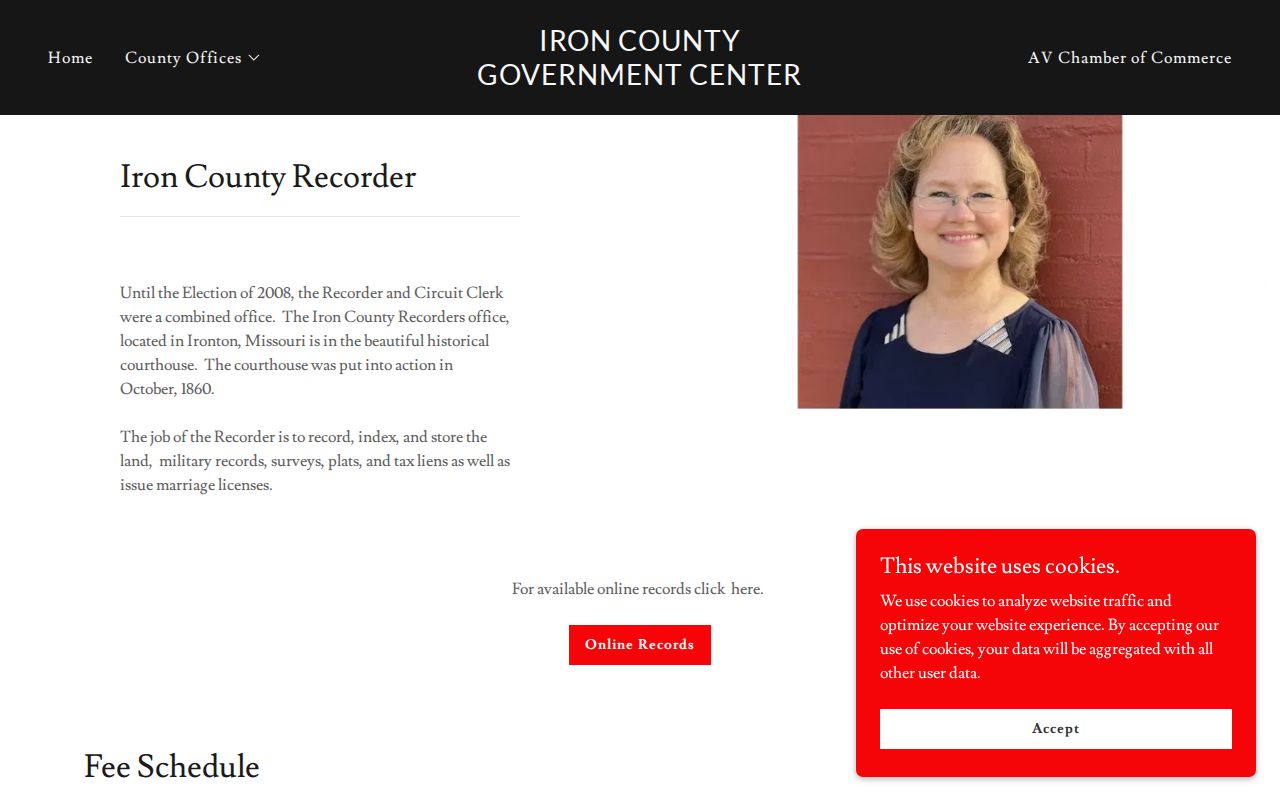
Deeds and liens live with the Recorder. That office is not where a court case file sits. A judgment can be recorded there later, too. That still does not make the Recorder the keeper of the case file. The docket belongs to the clerk. Send anything judicial to the Circuit Clerk. Route county-government records through the County Clerk's Sunshine process.
Note: Older references may mention a combined Recorder and Circuit Clerk office. According to the Recorder's own history, the two offices split after the 2008 election.
Court Record Types in Iron County
The Iron County Circuit Clerk’s official description covers a wide span of court work. A request might seek a docket sheet, a judgment, an order, a public pleading, a hearing calendar, or a certified copy. Getting the name right matters. The docket sheet is the chronological register of events. A judgment is the court’s decision. A transcript runs through the court reporter or the clerk’s routing instructions. And a certified copy carries the clerk’s authentication. That sets it apart from an ordinary inspection copy.
- Criminal and traffic docket entries, public orders, and available judgments.
- Civil case files, motions, judgments, satisfactions, and vacated-order entries.
- Probate, domestic, and juvenile records, subject to their access limits.
- Municipal-division files administered as circuit-court records.
- Hearing schedules, calendars, and public case-number indexes.
A name search is only an index path, not the finish line. The Circuit Clerk can help you tell a case sheet from a whole file, a court order from a Recorder instrument, and a public attachment from a protected one. For an active case, give the exact document title or docket-entry date whenever you can.
Historical Iron County Court Books
Case.net is a modern statewide index. It will not answer every question about nineteenth- and early twentieth-century Iron County court records. The Missouri State Archives Iron County guide identifies circuit indexes for 1912–1930 and 1930–1954 that are not indexed online in the guide. It also lists circuit-court volumes beginning in 1857. Selected early volumes are online. Many later series remain as reels, boxes, or other nondigitized records. The Recorder’s office history says the county courthouse went into action in 1860. With that much past, an older Iron County court record may call for questions both locally and at the archives. Give staff the year, the court type, and the party names. An empty Case.net result never proves a historical case did not exist. For county-court minutes or older court books, the State Archives county resources explain the difference between circuit case files, county-court books, and Judicial Records Database material. Treat this as a research route, not a promise that every volume is online.
Inside an Iron County Court Record
No single fixed look defines an Iron County court record. The case category shapes the fields, and public access shapes what you can see. Missouri Court Operating Rule 4 supports indexes by party name, case number, and filing date. It also supports calendars and judgment records. The case header identifies the matter at a high level. Docket entries then record events in date order. A document link signals a potentially viewable attachment. It is not a guarantee that every filing opens remotely.
| Case number | A unique court identifier, such as a year, location, category, sequence, and possible suffix. 2026-CR-00001 is only a generic example. |
|---|---|
| Case header | The court, case category, filing date, case style, and parties shown at the user’s access level. |
| Docket entries | A dated register of filings, hearings, notices, orders, judgments, and other procedural events. |
| Orders and judgments | Public court rulings or adjudications when the document is available and not restricted. |
| Hearing setting | The scheduled event date, time, judge, location, and event type, which can change before court. |
| Access marker | An available link, ECASE indicator, or confidentiality limit that affects how the file can be viewed. |
One field tells you very little. A filed case is not a finding, and a future hearing date is not an outcome. A satisfaction or vacatur entered later can even change what a judgment means.
Iron County Electronic Record Access
Electronic access comes in two layers. Case.net is the public search and docket path. Missouri eFiling and the file viewer handle electronic documents. Your role and security settings shape that access. The official file-viewer help notes that a hyperlinked docket entry can point to an attachment. A nonhyperlinked entry may mean no attachment exists, or that the user lacks access. An ECASE marker signals an all-electronic file. It does not promise remote availability for every item. Broader remote access to public documents began July 1, 2023, per official court guidance. Older documents usually still require a courthouse terminal. For a public terminal, inspection, current hours, or a copy request, contact the Circuit Clerk's office. The address is 250 South Main Street, Ironton, Missouri 63650. Call 573-546-2511 or email ironcounty@courts.mo.gov before making a special trip. That chain of access guards against a common error. It stops you from treating an online docket entry as proof that the whole file can be downloaded. The clerk can explain the route that fits your case without disclosing anything restricted.
Fees and Certified Copies
The Iron County Circuit Clerk posts no current copy or certification fee schedule. Publishing a local price as settled fact would be risky. Missouri's general copying and research statute, RSMo §610.026, offers public-record context, but court records can involve separate clerk, certification, transcript, or statutory cost rules. Ask for a current estimate before ordering anything.
| Requested item | What the research establishes |
|---|---|
| Iron County ordinary court copy | Current local amount was not located. Confirm with the Circuit Clerk. |
| Iron County certified court copy | Current local amount was not located. Ask whether certification is available for the document. |
| Transcript | RSMo §488.2250 provides a statutory framework; ask the court reporter or clerk about current charges and delivery. |
| County-government request | The county policy uses estimated reproduction-cost deposits and may require advance payment for broad searches. |
Iron County Circuit Clerk
250 South Main Street
Ironton, MO 63650
573-546-2511
A certified copy is an authenticated clerk product. Ask for it by name, and ask whether a plain copy, certified copy, transcript, or simple inspection will serve your purpose. The format you choose can affect both access and cost.
Iron County Court Request Wording
A narrow request gives the clerk a real starting point. It also avoids asking the court to build a record that does not exist. Cite the exact Iron County case number. Or give a name plus an approximate filing year. Say what you want: a docket sheet, a judgment, a particular order, date-range entries, or a certified copy. Then ask whether the item is public. Ask what it will cost, which payment the office takes, and whether pickup, mail, or electronic delivery is available.
For county-government records, the 2025 Sunshine Request Policy shows the habits that work. Put the request in writing. Expect an estimate or deposit, and use inspection to trim a costly search. Follow the stated response process. None of that replaces the judicial clerk's own record process. A request that mixes court and county material should be split between the Circuit Clerk and the County Clerk. Never assume one office holds everything.
The Missouri State Auditor's Iron County hub covers county administration. It offers no court docket search.
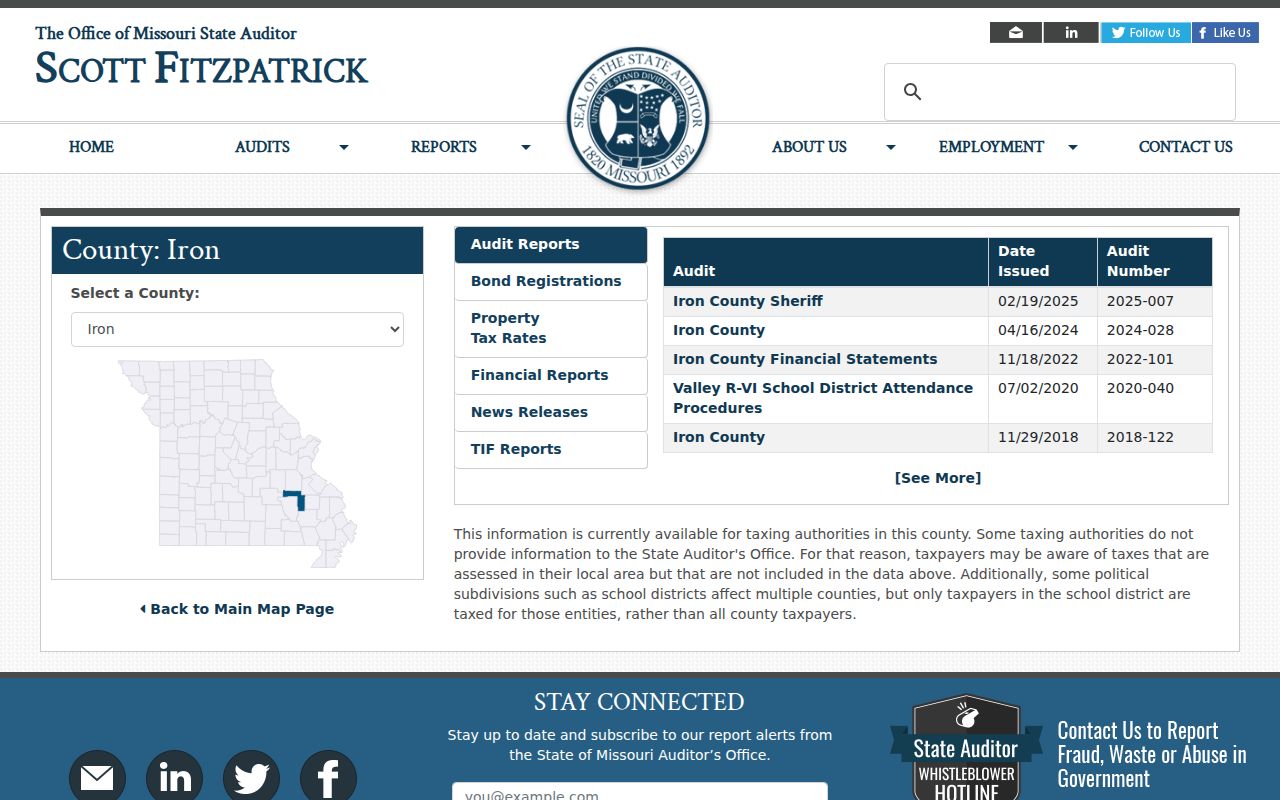
County audits and political-subdivision reports can answer an administration question. They do not replace a docket sheet, a court judgment, or a clerk-certified copy.
Sealed Iron County Court Records
Public access has limits. A Case.net result can show a header or docket entry while withholding the attachment behind it. Missouri's redaction statute, RSMo §509.520, shields certain categories. Those include full Social Security numbers, complete financial-account information, full operator-license or state-ID information, minors' identifying information, and protected birth-date information. Juvenile, family, medical, safety-related, sealed, and expunged material can carry stronger restrictions. The statute draws the line between a public case record and protected identifiers.
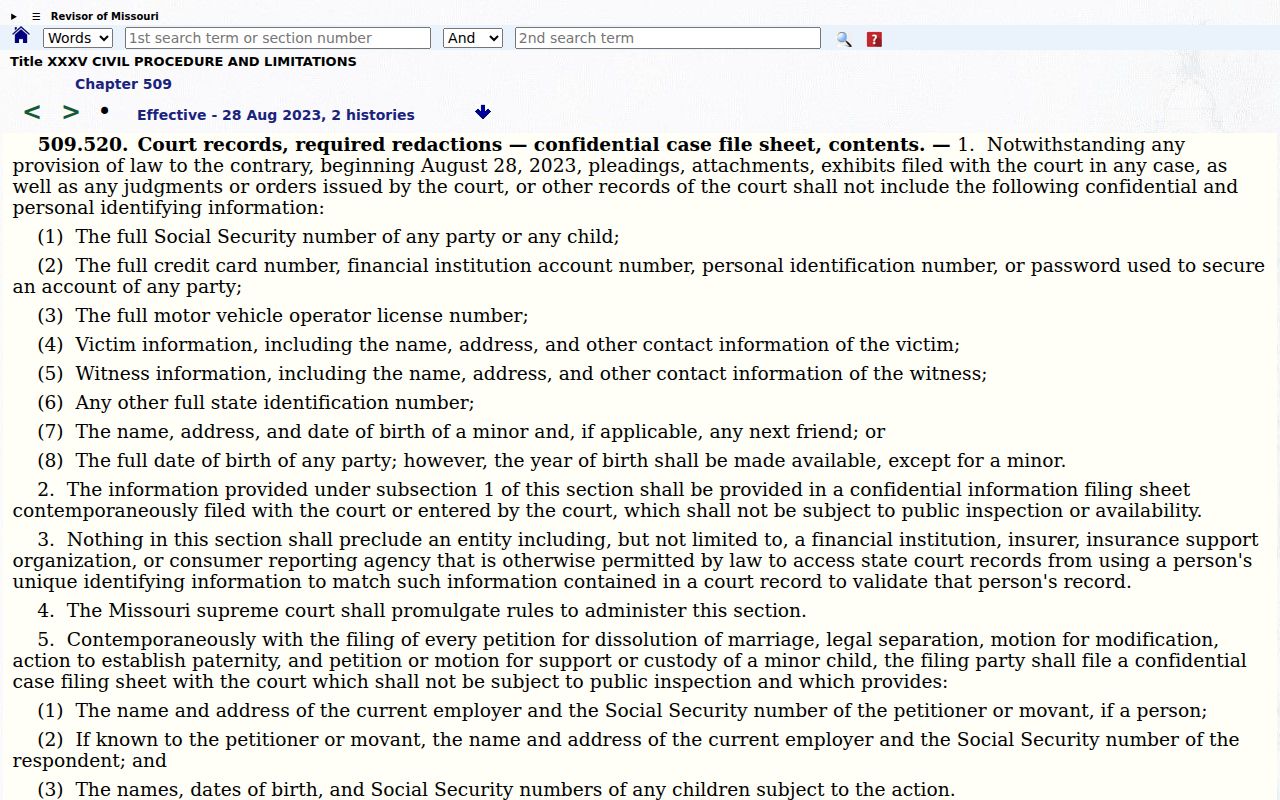
A missing document does not mean a vanished case. It may be confidential, sealed, expunged, indexed differently, transferred, or readable only at a courthouse terminal. Ask the Circuit Clerk what public portion, if any, can be inspected or copied.
Missouri access rules:
Court Operating Rule 4 supports court automation, public access equipment, indexes, calendars, and judgment records, subject to access limits.
RSMo §610.011 states Missouri’s policy favoring open records, while court rules and other laws can control a judicial record.
RSMo §610.120 limits general public access to closed records.
RSMo §610.140 describes the expungement process and confidential treatment after an order.
Note: A public-record request cannot reopen a closed court file or override a confidentiality order.
Iron County Court Record Follow-Up
Follow up with the same focused details as your first request. Include the case number, record type, approximate date, preferred format, and certification need. The Circuit Clerk keeps trial and hearing schedules along with case files. Confirm any current setting directly before you travel. For a historical matter, add the year range. Then ask whether the local file, the State Archives, or both is the better source. For online indexing, start with the Iron County case lookup route. Then return to the Circuit Clerk with an exact identifier. That order cuts the risk of requesting the wrong case or a similarly named person's file.